

How to Optimize for AI Search Results 2025
Search is changing fast — and businesses that don’t evolve will get left behind. AI tools like ChatGPT, Bing Copilot, and Google Search Generative Experience (SGE) are reshaping how customers find and trust brands online. Is your website ready to be found? Is it optimized for AI search results?
How to Get Found in AI Search: Maryland Web Design's 2025 Guide to Smarter SEO
As artificial intelligence reshapes how people discover businesses online, SEO is entering a new era. From Google SGE (Search Generative Experience) and Bing Copilot to ChatGPT and Perplexity, search results are no longer just about links and keywords — they’re about relevance, structure, and trust.
To stand out, your business must combine traditional SEO foundations with next-generation strategies tailored for AI-driven search. Here’s how Maryland Web Design helps clients stay visible in this changing digital landscape.
🔍 1. Traditional SEO (Still the Foundation)
AI tools still rely on classic SEO signals to understand and rank web content. A strong base is essential:
On-Page Optimization: Ensure strategic placement of keywords, optimized meta tags, title tags, H1 headers, image alt text, and internal linking. Example: For a page targeting “Baltimore web design company,” include relevant phrases in headers and metadata.
Technical SEO Audits: Crawlability, mobile responsiveness, HTTPS security, and fast load speeds are musts. Tools like Google Search Console and SEMrush help identify issues that can limit both traditional and AI search visibility.
Search-Intent-Driven Content: Blogs, FAQs, and service pages should match what your target audience is asking. A post like “Top SEO Mistakes Baltimore Businesses Make” targets real user queries.
Authoritative Backlinks: AI algorithms weigh trust. Earning links from credible sites like industry associations or local press (e.g., Baltimore Business Journal) builds authority.
Why it matters: Traditional SEO elements still feed the training data that large language models and AI search platforms rely on to determine relevance and credibility.
🤖 2. AI-Specific SEO Strategies
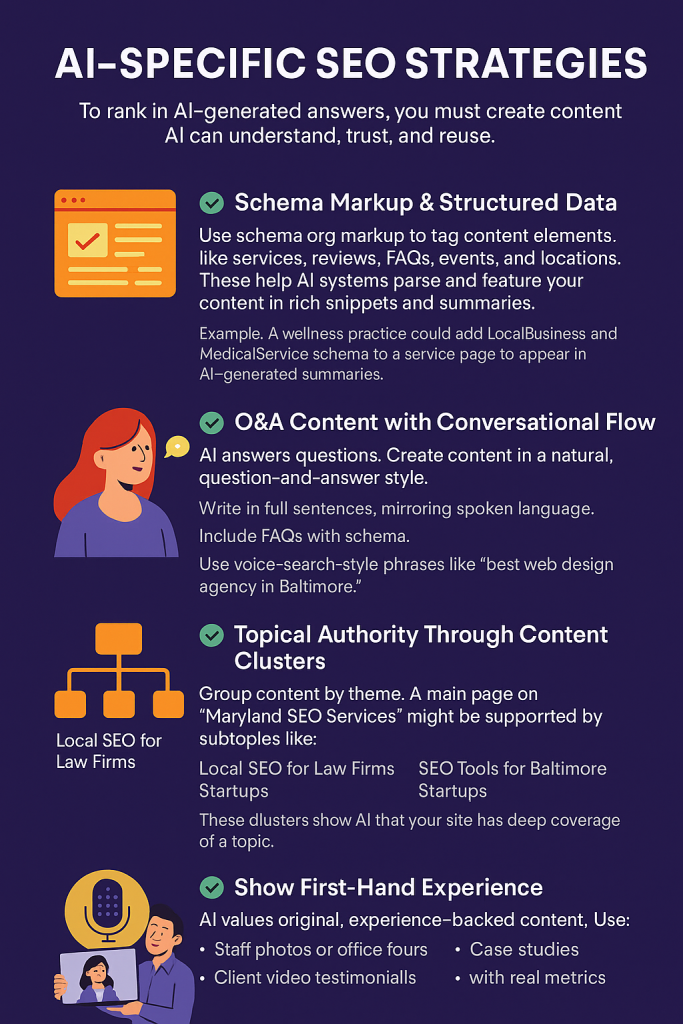
To rank in AI-generated answers, you must create content AI can understand, trust, and reuse.
✅ Schema Markup & Structured Data
Use schema.org markup to tag content elements like services, reviews, FAQs, events, and locations. These help AI systems parse and feature your content in rich snippets and summaries.
Example: A wellness practice could add LocalBusiness and MedicalService schema to a service page to appear in AI-generated summaries.
✅ Q&A Content with Conversational Flow
AI answers questions. Create content in a natural, question-and-answer style.
Write in full sentences, mirroring spoken language.
Include FAQs with schema.
Use voice-search-style phrases like “best web design agency in Baltimore.”
✅ Topical Authority Through Content Clusters
Group content by theme: A main page on “Maryland SEO Services” might be supported by subtopics like:
Local SEO for Law Firms
SEO Tools for Baltimore Startups
Content Marketing vs. PPC
These clusters show AI that your site has deep coverage of a topic.
✅ Brand Mentions (Even Without Links)
AI crawlers identify brand names across the web. Even unlinked mentions in media, podcasts, or forums increase visibility.
Get your name into:
Industry roundups
Local business features
Community events
✅ Show First-Hand Experience
AI values original, experience-backed content. Use:
Staff photos or office tours
Client video testimonials
Case studies with real metrics
Reviews with images or screengrabs
📍 3. Local SEO That Supports AI Discovery
Local search visibility still matters — and AI-enhanced search engines depend on accurate local data.
✅ Optimize Your Google Business Profile
Use accurate keywords like “Pikesville web developer” or “Deep Creek Lake cabin rental”
Add professional photos, business hours, categories, and customer FAQs
Ask clients for reviews mentioning local services
Example: A Baltimore HVAC company could answer “Do you service Towson homes?” in the Q&A section to show up in local AI queries.
✅ NAP Consistency
Your business Name, Address, and Phone number must be identical across:
Google
Facebook
Yelp
Local directories
Use tools like BrightLocal or Whitespark to audit and correct discrepancies. Inconsistent data reduces trust with AI and traditional search alike.
💡 4. Be Present in AI-Referenced Directories
AI models reference structured content from trusted public directories.
General Platforms:
Google Business Profile
Yelp
BBB
Facebook Business
LinkedIn
Industry Specific:
Medical: Healthgrades, Zocdoc, WebMD
Home Services: Angi, Houzz, HomeAdvisor
Tech & SaaS: G2, Clutch, Capterra
Why It Matters:
Being listed in these sources strengthens your business profile in:
AI-generated knowledge panels
ChatGPT responses
Local suggestions and “best of” lists

✨ 5. Create Content Built for AI Indexing
AI engines like SGE and Perplexity index content with structure, authority, and depth.
🧠 Demonstrate E-E-A-T
(Experience, Expertise, Authority, Trust)
List author bios with credentials
Include images, stats, testimonials
Cite reputable sources
Example: A blog called “Baltimore SEO Trends for 2025” that includes data, interviews, and visuals will outperform a generic listicle.
🔁 Update and Refresh Content
Revise old blog posts with new info
Add updated metadata and internal links
Use tools like SurferSEO to re-optimize
🧩 Make It Easy to Skim
Use keyword-rich H2/H3s
Add bullet points and summaries
Optimize image alt-text and filenames
Use schema markup for articles and FAQs
💡 Publish Deep, Useful Guides
“Complete Guide to SEO for Maryland Law Firms”
“How to Design a Website That Ranks in AI Search”
Long-form, helpful content gives AI tools more to pull from.t.
✅ Final Thoughts: Maryland Web Design Can Help You Win AI Search
SEO is no longer just about Google — it’s about staying visible in AI-powered platforms that answer questions, generate recommendations, and influence buying decisions.
To stay ahead, focus on:
Clean structure and schema
Conversational, Q&A-style content
Local SEO and citations
Strategic content refreshes
Authoritative, original media
Need help getting started?
📞 Contact Maryland Web Design at 410-404-0663 or www.mdwebcorp.com
Let us optimize your content for both people and the AI models they trust.
FAQ's AI SEO
What is AI SEO and how is it different from traditional SEO?
AI SEO refers to optimizing content not just for search engines like Google, but also for AI-powered platforms like ChatGPT, Bing Copilot, and Google SGE. Unlike traditional SEO, which focuses on keywords and backlinks, AI SEO emphasizes structured data, conversational content, topical authority, and real-world brand signals.
Schema markup helps AI tools and search engines understand your content’s context. It tags elements like services, reviews, and FAQs — increasing the chance your content appears in featured snippets, knowledge panels, or AI-generated summaries.
How can local businesses appear in AI search results?
Local businesses should optimize their Google Business Profile, maintain consistent NAP (Name, Address, Phone) info across directories, and get mentioned in local blogs or press. AI tools rely on this trusted, structured data to answer location-based queries.
Content that is structured, informative, and demonstrates E-E-A-T (Experience, Expertise, Authority, Trust) ranks best. Use Q&A formats, rich visuals, updated stats, internal links, and original media like video walkthroughs or testimonials.
Backlinks still matter, but AI tools also consider unlinked brand mentions and topical relevance. A mention in a blog or forum—even without a hyperlink—can help your brand show up in AI summaries or recommendations.
Use tools like Google’s Rich Results Test, SurferSEO, or Schema Markup Validator to audit your content. Check if your pages are being pulled into featured snippets, AI summaries, or SGE panels — that’s a good sign you’re on the right track.
Use tools like Google’s Rich Results Test, SurferSEO, or Schema Markup Validator to audit your content. Check if your pages are being pulled into featured snippets, AI summaries, or SGE panels — that’s a good sign you’re on the right track.
They overlap. Optimizing for voice means using natural language, answering questions directly, and including structured data. These strategies also support AI optimization since many AI tools mimic voice-style queries.
Refresh key blog posts and landing pages at least every 6–12 months. Update stats, add internal links, enhance readability, and improve multimedia. AI favors fresh, context-rich content over outdated or generic pages.
It can — but only when it’s well-edited, original, and adds value. AI-generated content must be fact-checked, personalized, and formatted properly (e.g., schema markup, image alt text, and clean HTML) to perform well in AI search tools.
We specialize in blending traditional SEO with emerging AI strategies — from schema and site audits to content clustering, local SEO, and AI-specific content creation. We stay ahead so your business stays seen.
Subscribe to our newsletter
A free newsletter on digital marketing, AI, web design, SEO, social media, hosting and information on trends, resources and tips on how to maximize your online business.